
Friday, October 24, 2014

Thursday, October 23, 2014
Thursday, October 2, 2014
Thursday, June 19, 2014
Made with Code
Do you want to try coding AND get a cool bracelet? It's super easy and fun! I honestly just made two.
- Go to www.madewithcode.com
- Scroll down and click on the purple "code a bracelet".
- Follow the instructions on the screen to code your bracelet.
- Put in your shipping information and verify you are you
- Your bracelet gets sent to a 3D printer
- Wait 3-4 weeks to get yours in the mail! Send me a picture when you get yours!
Thursday, June 12, 2014
What a cool project!

Click here to check out this awesome article about a 2nd grade project about researching what kind of business should go into the former Pine's Men's Shop in Uptown Park Ridge. The kids did an amazing job presenting and were so engaged in the process! Way to go Ms. D and the 2nd grade team!
Thursday, March 20, 2014
Doodle for Google
Some of our students here at Roosevelt just participated in the Google for Doodle competition. Students were challenged to create a Google Doodle with the following theme:
"If I Could Invent One Thing to Make the World a Better Place"
"If I Could Invent One Thing to Make the World a Better Place"
Check out our submissions below!
Wednesday, March 5, 2014
Finding a Balance with Screen Time

One concern that parents and teachers often have when using technology is the topic of screen time and are our students getting too much screen time. Media is everywhere for our students from T.V., Internet, Computers, iPads, Video Games, Cell Phones, etc. According to the American Academy of Pediatrics, children today are spending an average of seven hours a day with entertainment media.
At school, our goal is to purposefully plan the use of technology in order to enhance instruction. As teachers, we ask three questions to make sure we are planning to use technology effectively in the classroom:
- Is it appropriate?
- Is it meaningful?
- Is it empowering?
By asking ourselves these three questions, we are ensuring that we are using technology to enhance learning in a purposeful way, not just using iPads for example, to use iPads. There are so many technology tools that enhance learning as well as other hands on manipulatives that don't use technology that as teachers, we need to make sure we keep a good balance of using both technology resources and non technology resources to make learning engaging and meaningful for kids.
At home, it's important that screen time is balanced as well. The American Academy of Pediatrics suggests the following ideas for parents:
- Parents can model effective “media diets” to help their children learn to be selective and healthy in what they consume. Take an active role in children’s media education by co-viewing programs with them and discussing values.
- Make a media use plan, including mealtime and bedtime curfews for media devices. Screens should be kept out of kids’ bedrooms.
- Limit entertainment screen time to less than one or two hours per day; in children under 2, discourage screen media exposure.
 Do you think your family needs a media plan or media diet? You can visit AAP's partner site, healthychildren.org, for tips on creating a Family Media Use plan. Even if you don't formally create a plan for your family, there are some great talking points to be considered for children and adults alike. Common Sense Media also has some guidelines for elementary schoolers and middle schoolers in creating a family media plan.
- Start with an endpoint. Use whatever tools you have -- your DVR, Netflix, OnDemand -- to pre-record shows, cue them up, or plan ahead to watch at a specific time. That way, one show won't flow into the other, and you can avoid commercials. If your kids are into YouTube, search for age-appropriate videos, and add them to a playlist to watch later. Because most games don't have built-in endings (and are, in fact, designed to make kids play as long as possible), set a timer or some other cue that says "time to stop."
- Help them balance their day. Kids this age need guidance from you on a daily plan that includes a little bit of time for everything. And staying involved works: Kids whose parents make an effort to limit media use spend less time with media than their peers do, according to a 2010 Kaiser Family Foundation study.
- Practice what you preach. It's tempting to keep reaching for your phone to check email, texts, Facebook, or the news. But your kids will be the first to call you out for not "walking the talk." Plus, they'll pick up habits from you. Model the media behavior that you want your kids to emulate.
I've posted an infographic about screen time in the past - please click here to check it out. Here's another infographic about Screen Time and Play Time.
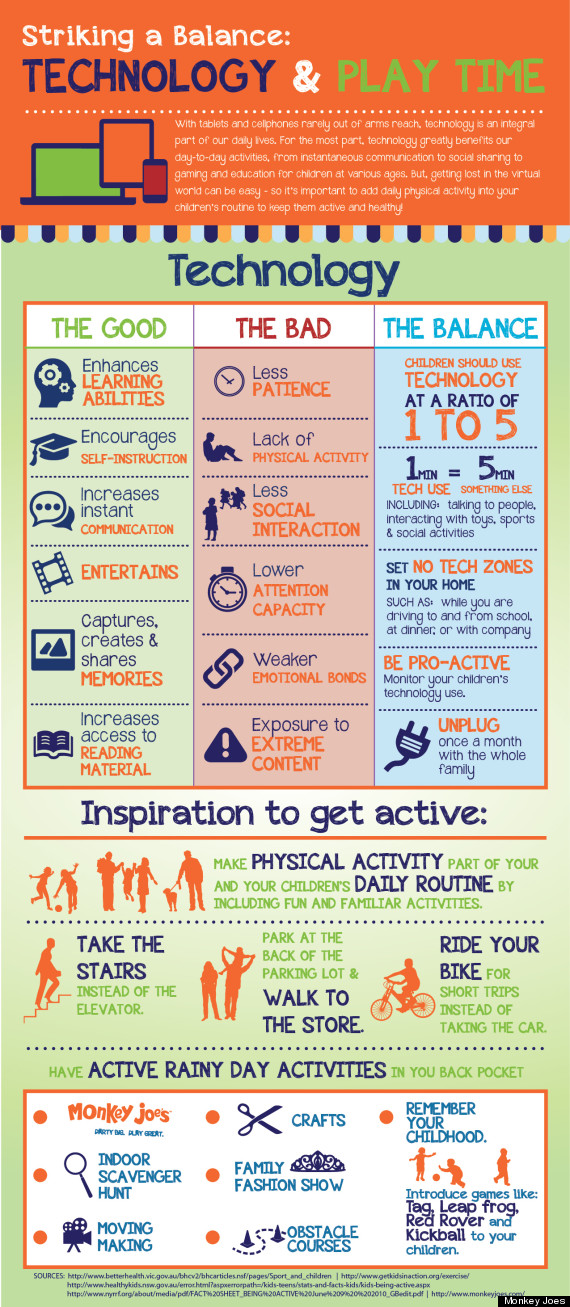
Like anything in life, the real answer is balance. Finding something that works well for you and your family. I know that writing this post has brought a lot of ideas for me to share with my husband about our three kids and screen time, as well as the important part of practicing what we preach. I hope you have found this information useful!
Please feel free to leave comments below if you have ideas for future posts or would like to see something featured on the blog. It's great to be back!
Resources:
Holland, Beth. "The Balance of Screen Time." Edutopia. Edutopia, 09 Sept. 2013. Web. 05 Mar. 2014. <http://www.edutopia.org/blog/balance-of-screen-time-beth-holland>.
Knorr, Caroline. "How to Set Screen Rules That Stick." Reviews & Age Ratings. Common Sense Media, 11 Sept. 2012. Web. 05 Mar. 2014. <http://www.commonsensemedia.org/blog/how-to-set-screen-rules-that-stick>.
"Managing Media: We Need a Plan." Managing Media: We Need a Plan. American Academy of Pediatrics, 28 Oct. 13. Web. 03 Mar. 2014. <http://www.aap.org/en-us/about-the-aap/aap-press-room/Pages/Managing-Media-We-Need-a-Plan.aspx>.
"Media and Children." Media and Children. American Academy of Pediatrics, n.d. Web. 03 Mar. 2014. <http://www.aap.org/en-us/advocacy-and-policy/aap-health-initiatives/pages/media-and-children.aspx>.
Velez, Mandy. "A Practical Guide To Balancing Screen Time And Play Time." The Huffington Post. TheHuffingtonPost.com, 24 Jan. 2014. Web. 05 Mar. 2014. <http://www.huffingtonpost.com/2014/01/24/balancing-tech-and-playtime-infographic_n_4653793.html>.
Thursday, December 19, 2013
BrainPOP & BrainPOP Jr.
 |
| 1st and 2nd graders are already utilizing BrainPOP at home! |
BrainPOP creates animated, curriculum-based content that supports educators and engages students. Hundreds of topics within Science, Social Studies, English, Math, Technology, Arts & Music and Health are all brought to life through short, animated movies and related interactive quizzes and features. BrainPOP Español provides BrainPOP content in Spanish. All content is aligned to and searchable by state standards.
BrainPOP Jr. provides educational movies for K-3 learners and addresses a wide range of grade-appropriate topics. Each animated topic has a movie, leveled quizzes, games, activities, and lesson ideas that develop critical thinking and inquiry skills. All content is read aloud so young students can browse the site on their own. Because BrainPOP and BrainPOP Jr. are delivered entirely online, there’s nothing to install or download. You can use BrainPOP resources with PCs, Macs, projectors, and interactive whiteboards. Getting started is easy by using the step-by step Getting Started Guide. There is also a free app you can download to use Brain POP & Brain POP Jr. on your iphone, iPad, etc.
Your child’s subscription to BrainPOP will remain active for the school year, 24 hours a day, in which time they will have full access to all the movies, quizzes, and interactive resources both at home and at school. Questions? Feel free to contact BrainPOP at 866.542.7246 or e-mail me and I’ll be happy to help you.

Monday, December 9, 2013
Connected Classroom Hangout: Danny the Champion the World with Lucy Dahl

I'm posting a little bit earlier this week to share a very cool activity that just took place at Roosevelt School. Today, Mrs. Filipiak's 3rd grade classroom had a very unique opportunity. Before Thanksgiving, they were sent copies of the book, Danny, the Champion of the World by Roald Dahl. Over Thanksgiving Break the third grade students read the book and when they returned, submitted questions in preparation for today's Connected Classroom Hangout with Lucy Dahl, Roald Dahl's daughter, and with Elizabeth Findley who works with Matilda, the Musical, on Broadway. It was a BEYOND amazing experience for the students who personally got to interact with both Lucy in Los Angeles and Elizabeth in New York. Lucy had some amazing information to share about her father and the kids and adults involved learned a lot! Some students even were able to make some very unique and interesting connections with Roald Dahl. As a big "Oprah type" surprise at the end, the students received the book, Matilda, as a thanks for participating gift. They were beyond thrilled. Check out the video of the entire experience in the YouTube Video below. Thank you to +Matilda The Musical Broadway and +Connor Swenson for such an amazing opportunity!
Thursday, December 5, 2013
Samples of Success: Room 312's Survival "Handbook"
Currently, Mr. Mulvihill's 5th grade class is in the middle of their rotation of using the Chromebooks as well as just finished reading the novel, My Side of the Mountain. Mr. Mulvihill has traditionally read this novel with his 5th grade class and has had the students keep track of different plants and animals that are used as a means of survival, while reading the novel. This year, with the Chromebooks at Room 312's fingertips, they were were able to take this survival study a bit further. In collaborating with myself, the Instructional Technology Coach, and Ms. Diekman, we were able to come up with an awesome project ot take their findings a step further. Ms. Diekman, our wonderful Library Information Specialist, worked with Room 312 showing them how to research and take notes on the different survival items that were in the novel they read. After completing the research with Ms. D, then I went into his classroom to teach the kids how to use Google Sites. As a class, collaborating on research and collaborating on creating a website, you can see how their hard work has transformed into a wonderful working website. Please click here to view the website.

 This project was a great way to meet many of our National Educational Technology Standards (NETS) while deepening the student's understanding of how different plants and animals can be used for
survival. In addition to meeting the NETS standards for students, this activity also met a variety of the Common Core State Standards for English Language Arts.

 This project was a great way to meet many of our National Educational Technology Standards (NETS) while deepening the student's understanding of how different plants and animals can be used for
- CCSS.ELA-Literacy.RL.5.10 By the end of the year, read and comprehend literature, including stories, dramas, and poetry, at the high end of the grades 4–5 text complexity band independently and proficiently.
- CCSS.ELA-Literacy.W.5.6 With some guidance and support from adults, use technology, including the Internet, to produce and publish writing as well as to interact and collaborate with others; demonstrate sufficient command of keyboarding skills to type a minimum of two pages in a single sitting.
- CCSS.ELA-Literacy.W.5.7 Conduct short research projects that use several sources to build knowledge through investigation of different aspects of a topic.
- CCSS.ELA-Literacy.W.5.8 Recall relevant information from experiences or gather relevant information from print and digital sources; summarize or paraphrase information in notes and finished work, and provide a list of sources.
Mr. Mulvihill's class did an amazing job on this assignment, and their website looks amazing! I hope you enjoy reading their hard work and seeing an excellent sample of success from our 5th graders!
Thursday, November 21, 2013
Hour of Code
We live in a world surrounded by technology. But only a tiny fraction of students learn how computers work, or how to create software technology. Computer Science provides a foundation for virtually any career and all our students can benefit from learning the basics.
This year, for Computer Science Education Week, a massive campaign called the Hour of Code is introducing 10 million students to try one hour of introductory computer science.
Watch the video below to find out more or check out the Hour of Code website by clicking here. At Roosevelt, we are offering the Hour of Code to classrooms, and the computer club is participating during their meeting. You can also participate at home if you'd like! Check out the Hour of Code website if you are interested.
I hope everyone has a restful and relaxing Thanksgiving Break!
Thursday, November 14, 2013
iPads in K-2 at Roosevelt
As you may or may not know, in Kindergarten through Second Grade, our classrooms have 1 iPad for every 4 students in their classrooms. Each teacher is implementing these iPads in a way that best fits the needs of their classrooms, so it will not be the same in each classroom. However, one of the questions that our primary teachers have been asked is what apps are on the iPads and where can we download them? As of today, we now have these apps in a location for parents to see what apps are on the iPads and a link for you to download them. Please take a moment to check out the new iPad Apps site! If you have any questions, please let me know!
 |
| Check out the new RO iPad App Site |
Wednesday, November 6, 2013
Common Sense Media: A Great Resource for Families
 Common Sense Media is a wonderful resource for families to utilize in terms of seeking out what's going on in the world of media - which is a huge part of our children's lives today. From movies, TV, apps, games, etc., Common Sense Media has a range of resources to help parents educate themselves on what's age appropriate and what's best for kids. Common Sense Media is dedicated to improving the lives of kids and families by providing the trustworthy information, education, and independent voice they need to thrive in a world of media and technology. You can access a variety of content from Common Sense Media just by going on their site, however, there are even more resources if you create a free account. Click here to visit Common Sense Media.
One thing that I highly suggest reviewing together as a family is the Digital Citizenship Section. It's important in the world we live in today to be open about what the expectations are for being a good Digital Citizen, and how to stay safe online. By law, we teach students on a yearly basis about what it means to a good digital citizen at school. Common Sense Media has some great resources for how to continue this conversation at home. Click here if you'd like to read more and to see a helpful video you can share with your children.
If you'd like to see a topic featured on the Roosevelt Bits and Bytes Blog, please leave a comment below. I'd love to know what topics you'd like to see featured! Thanks for reading!

Thursday, October 31, 2013
Virtual Field Trips
What is a Virtual Field Trip?
A Virtual Field Trip is when we a class can connect with an expert on a topic via a Google+ Hangout, a Google product similar to Skype allowing you to connect with various experts and/or classrooms at the same time. Last year we participated in quite a few Virtual Field Trips, and this year, we are hoping to do the same. Many of the institutions that offer Virtual Field Trips are Zoos, Aquariums, and Museums around the country. This is a great free way to bring experts into the classroom, and give students an interactive experience not only with experts, but other students around the country. Today, Mrs. Kulnig's 4th grade class participated in a Virtual Field Trip to the Atlanta Zoo called Myths and Misconceptions.
It’s that time of year when everything seems a bit spooky! Are your fears of spiders, snakes and other creepy-crawlies based on facts or fiction? Cozy up to some of Zoo Atlanta’s “creepiest” creatures to find out how you might be giving some of the world’s most important animals a bad rap.
On the Virtual Field Trip today, we met Quincy the Eurasian eagle owl, Maize the corn snake and Georgette the Tarantula. Our Roosevelt 4th graders did an awesome job asking questions and participating in the Virtual Field Trip. I'm hoping that we'll be able to have many classes participating in these Virtual Field Trips this school year. If you'd like to see the field trip, watch the video above!
 |
| Up close and personal with Georgette, the tarantula at Zoo Atlanta. |
 |
| "Hanging Out" with Quincy the Owl. |
Wednesday, October 23, 2013
RAZ-KIDS iPad App

You can also monitor your child's progress using Raz-Kids. You can see which books your student has been reading, send them messages, and review all their activity with our Parent Access area. Simply log in as your student, click the "Parents" link in the top right, and register.
Our Roosevelt teachers are currently in the process of sending home the letters with log-in information for each student. If you have any questions about your students log in information, please contact your child's teacher and they can help. To access Raz-Kids, click on the picture above or scroll down to the helpful links section on the right hand side of the blog.
 Since we have subscriptions for our K-3 Students to Raz-Kids, we also have access to the Raz-Kids app for the iPad. This app lets you access eBooks and eQuizzes for the 300+ titles on Raz-Kids, all on your tablet! In addition to engaging kids at their reading level and in their area of interest, this award-winning resouces gives kids 24/7 Web access to the practice they need to become better, more confident readers. Please click here to download this FREE app to your iPad so that your students can have access to their eBooks and quizzes. If you have any questions or problems, please let me know and I'd be happy to help you troubleshoot.
Wednesday, October 16, 2013
What is a Chromebook?
 |
| Roosevelt 5th graders are using their Chromebooks for various assignments. |
Students and teachers have been using the Chromebooks over the past four weeks in a variety of different ways. A lot of work the students do on the Chromebooks is in their Google Drive. Their Google Drive have access to a variety of applications similar to the Microsoft Office Suite. The nice thing about Google Drive is that not only can you access your work anywhere with computer access, but you can also collaborate with peers in real time on a document, presentation, etc. Having the Chromebooks in the classroom all day every day (for six weeks) allows students access to online learning tools anytime, instead of teachers having to check out a computer cart to use it. Teachers so far are reporting that students are able to use the Chromebooks more than traditional laptops, and both the students and teachers are loving this instant access to information. I know that the three fifth grade classes are not looking to giving up the Chromebooks at the end of the month, however, two 3rd grade classes and one 5th grade class is very excited for this new addition in their classrooms. We are excited for these to be traveling around the school, and have an additional cart of Chromebooks for teachers to be checking out and using as well. We are hoping that one to one learning is something that we will see in the future at Roosevelt School. Look at what Sal Khan has to say about the possible future of education in this clip from 60 Minutes below. Do you see going one to one as a good idea in your child's classroom? I'd love to hear your comments by you posting below!
Wednesday, October 9, 2013
Teacher Technology Testimonial - Mrs. Marcell
Today's guest post comes from Mrs. Barclay Marcell. She is a literacy teacher that services students in 1-5 here at Roosevelt School. Mrs. Marcell received a SMART Board this year as a part of Roosevelt's 21 new SMART Boards that were installed this summer. Below she shares how technology, specifically SMART Boards, have changed her practice - in two short months.
 There is literacy intervention before SMART Boards and literacy intervention after SMART Boards.
The advent of the SMART Board has taken prescribed, program-driven reading lessons and brought them to the big screen. Literally. And along with it, a soaring level of student motivation and one excited teacher.
I think it was Einstein who said, "If I can see it, I can understand it."
 So, take a 3rd grade Read Naturally fluency text about wolves – no color, stilted language, with a quiz to boot. Interject a podcast narration and a National Geographic video clip of wolves hunting and howling. Follow that up with Garage Band timed readings and iMovie kid reporting. The result? Reluctant readers are fighting over which text to tackle next. And their teacher is tempted to do a cartwheel.
Take a Phonics for Reading decodable text excerpt such as Jack got a cod fish. Not exactly edge-of-your-seat material. Well, put the sentence on the SMART Board and suddenly 1st graders are clamoring to highlight vowels, to scoop phrases, and of course to draw a picture of fisherman Jack.
Take a sight word recitation exercise; add a SMART Board game from ABCya. Suddenly, you’ve got kids whose bank of known sight words was formerly in need of a bailout snapping and singing their the’s, what’s, and why’s.
 Take the Storytown robust vocabulary words; add a ready made PowerPoint on the SMART Board and now 4th graders are predicting, connecting, and acting out words.
Take the Storytown lesson of the week for 2nd grade; add the Think Central site on the SMART Board, and kids are now relating literacy lesson content to their classroom focus. Skills and strategies are reinforced and grades improve. Success breeds success.
Take a teacher who wants to spark a love of reading; add the creativity and visual appeal of the SMART Board, plus the invaluable assistance of an awesome technology coach, and what do to get? Comprehension and Cartwheels.
We see it; we understand it.
 There is literacy intervention before SMART Boards and literacy intervention after SMART Boards.
The advent of the SMART Board has taken prescribed, program-driven reading lessons and brought them to the big screen. Literally. And along with it, a soaring level of student motivation and one excited teacher.
I think it was Einstein who said, "If I can see it, I can understand it."

Take a Phonics for Reading decodable text excerpt such as Jack got a cod fish. Not exactly edge-of-your-seat material. Well, put the sentence on the SMART Board and suddenly 1st graders are clamoring to highlight vowels, to scoop phrases, and of course to draw a picture of fisherman Jack.
Take a sight word recitation exercise; add a SMART Board game from ABCya. Suddenly, you’ve got kids whose bank of known sight words was formerly in need of a bailout snapping and singing their the’s, what’s, and why’s.
 Take the Storytown robust vocabulary words; add a ready made PowerPoint on the SMART Board and now 4th graders are predicting, connecting, and acting out words.
Take the Storytown lesson of the week for 2nd grade; add the Think Central site on the SMART Board, and kids are now relating literacy lesson content to their classroom focus. Skills and strategies are reinforced and grades improve. Success breeds success.
Take a teacher who wants to spark a love of reading; add the creativity and visual appeal of the SMART Board, plus the invaluable assistance of an awesome technology coach, and what do to get? Comprehension and Cartwheels.
We see it; we understand it.
Wednesday, October 2, 2013
Roosevelt Recording Studio
Last year, a group of Roosevelt Teachers wrote a PTO grant for the Roosevelt Recording Studio. The Roosevelt Recording Studio is similar to an authentic production studio. Roosevelt’s Recording Studio would is complete with dedicated equipment including a tripod, a digital camera, a green screen wall, a microphone, and a computer for editing and publishing. The studio provides educational opportunities that embellish curricular content while increasing student motivation and engagement.
The ELA Common Core State Standards are inherently targeted within the learning objectives of the Roosevelt Recording Studio – specifically as they relate to anchor standards cited in Reading-Informational Text, Language, Writing, Speaking and Listening .
Students, or Roosevelt Reporters, will participate in activities including, but not limited to, the following –
- Paraphrasing main ideas from grade-level articles on current events.
- Developing a Kid-News script based on a close reading of online source materials – articles from Time for Kids, Scholastic News, etc.
- Practicing oral reading fluency skills by rereading for the purpose of incorporating expression and performing.
- Learning and practicing production skills related to imovie software (uploading, editing, using a green screen and layering backdrops related to content).
The studio is already up and running for the school year! We've had various classrooms already recording in the recording studio, and many teacher including in their upcoming plans. We also just recently received a grant from Donor's Choose to add two new cameras to our recording studio! Hopefully we'll be able to start posting some examples on this page.
Thank you so much to the Roosevelt PTO for making the Roosevelt Recording Studio a possibility for our students!
 |
| A class in action using the Roosevelt Recording Studio. |
Wednesday, September 25, 2013
Podcasting for Fluency

- Read to Self
- Work on Writing
- Word Work
- Listening to Reading
- Read to Someone
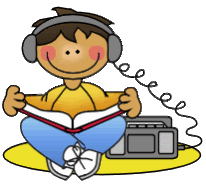 Currently, many teachers are working on building up these routines in their classrooms and getting in the groove of these activities while the teacher works with small groups or conferences with individual students. I've been lucky enough to plan some lessons with teachers to help infuse technology in the Daily Five. I've been training classrooms and working with individual students on Podcasting as a part of the "Listening to Reading" component. How this activity works is a student goes to the "Listening to Reading" Center where there are headphones with a microphone and a laptop that has the program Garage Band. Students then record themselves reading a passage or poem selected by their teacher. Once they record themselves reading, they then can listen to their recording and make notes on the page of what they've read. Students then save their Podcast, then fill out a self evaluation about their reading. By making this a regular part of the reading block, students will be able to go back and listen to themselves read and track improvement over time. Teachers can also go and listen to what the student records and have the ability to conference with their students with their Oral Reading Fluency progress. Students can then set their own goals for improvement. Technology is changing how students learn in this activity as it is giving them the opportunity to go back and hear themselves read. We used to accomplish this task with whisper phones or PVC pipes where they could read to themselves but offered little opportunity for reflection. Everyone benefits from this use of technology!
 |
| A student records herself reading a poem. |
 |
| Here a student listens to their recording of himself reading a poem. |
Wednesday, September 18, 2013
Technology at Roosevelt Elementary School
On Wednesday, I had the opportunity to present to the Roosevelt School PTO about the Technology currently used at Roosevelt School. This year, as you may or may not be aware of, we have greatly increased the amount of technology students and teachers have access to. Below you will see highlighted a bit of what was added. I also plan on keeping a slide show on the right hand side of pictures of Technology in Action here at Roosevelt School. Please keep an eye out for all of the ways we are using technology here at Roosevelt. If you missed the PTO meeting last night and are interested in the the updates, please watch the brief slideshow below. Most of the links work with the exception of some of the student examples to for privacy purposes. If you have any questions, please feel free to email me, or use the contact form to the right to send me an email.
Subscribe to:
Posts (Atom)